Perception & Navigation
Understanding the Environment and Moving Through It
Perception and navigation are closely connected challenges in autonomous robotics. Before a robot can decide where to go, it must first understand where it is, what surrounds it, and how the environment is changing. The Crazyflie® platform provides a flexible foundation for developing and validating the sensing, localization, mapping, and planning capabilities that enable autonomous flight.
Researchers use Crazyflie to bridge the gap between algorithm development and real-world deployment, exploring everything from visual navigation and sensor fusion to obstacle avoidance and autonomous exploration. Its modular hardware, open software stack, and support for multiple localization technologies make it a practical platform for reproducible experimentation.
Research Opportunities
With Crazyflie, researchers can implement and evaluate:
- Visual-Inertial Odometry (VIO) and SLAM benchmarking.
- Sensor fusion for localization and state estimation.
- Navigation and motion planning in GPS-denied environments.
- Reactive navigation and dynamic obstacle avoidance.
- Embedded AI for perception-driven autonomy.
- Autonomous exploration, mapping, and environment understanding.
Each experiment benefits from full access to sensor data, configurable hardware, and a transparent software stack, allowing researchers to evaluate algorithms under controlled and repeatable conditions.
Research in Action
The Crazyflie has been used in studies ranging from visual navigation and autonomous exploration to obstacle avoidance and onboard perception. Researchers have leveraged the platform to investigate how robots perceive, localize, map, and navigate in environments where external positioning systems are unavailable or limited.
Projects involving visual-inertial navigation, probabilistic mapping, reinforcement learning for navigation, and onboard perception continue to demonstrate the value of lightweight aerial platforms as research testbeds.
Visual route following for tiny autonomous robots
TU Delft
NanoSLAM: Enabling Fully Onboard SLAM for Tiny Robots
ETH Zürich
Robust and Efficient Depth-Based Obstacle Avoidance for Autonomous Miniaturized UAVs
ETH Zürich
A Sim-to-Real Deep Learning-Based Framework for Autonomous Nano-Drone Racing
SUPSI
Sniffy Bug: A Fully Autonomous Swarm of Gas-Seeking Nano Quadcopters in Cluttered Environments
TU Delft, University of Barcelona, Harvard University
A 64-mW DNN-Based Visual Navigation Engine for Autonomous Nano-Drones
ETH Zürich
Reference Setup
Every project has unique requirements, but many share common building blocks. The configurations below provide practical starting points for perception and navigation research, combining sensing, localization, and compute capabilities commonly used in mapping, localization, and autonomous navigation experiments.
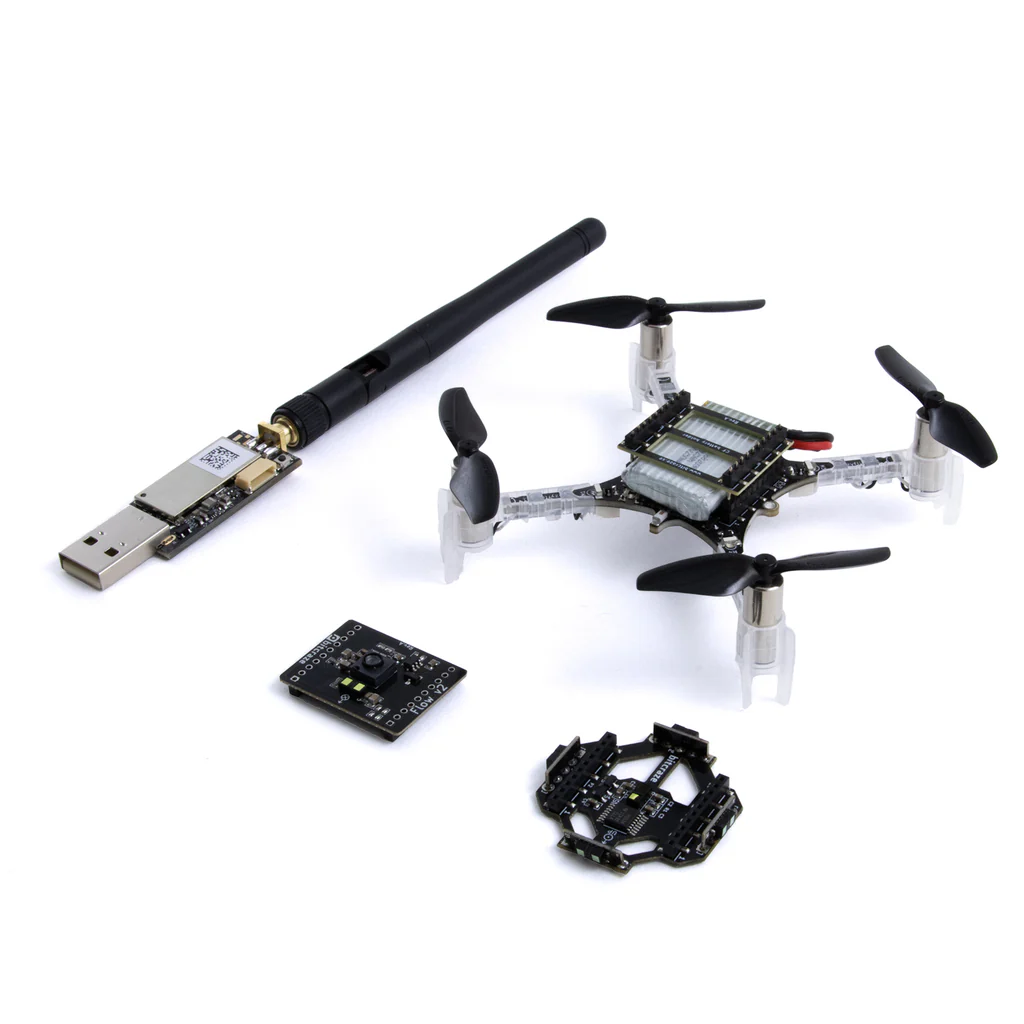
With the STEM ranging bundle you get everything you need for scripting and learning how to operate a robot in 3 dimensions and react to objects around it.
Shop Bundle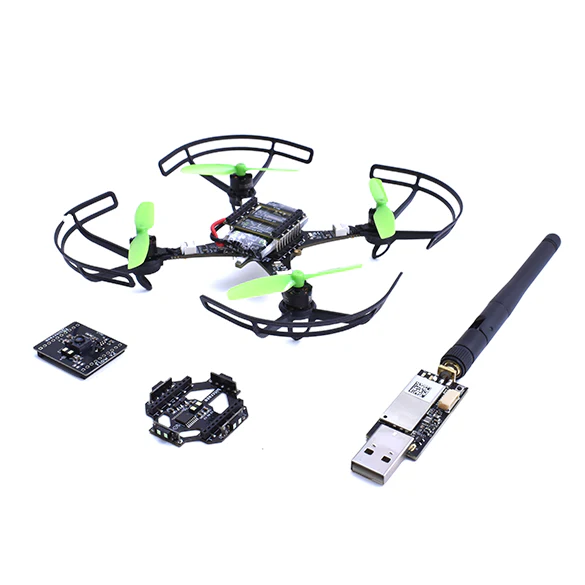
With the STEM ranging bundle you get everything you need for scripting and learning how to operate a robot in 3 dimensions and react to objects around it.
Shop Bundle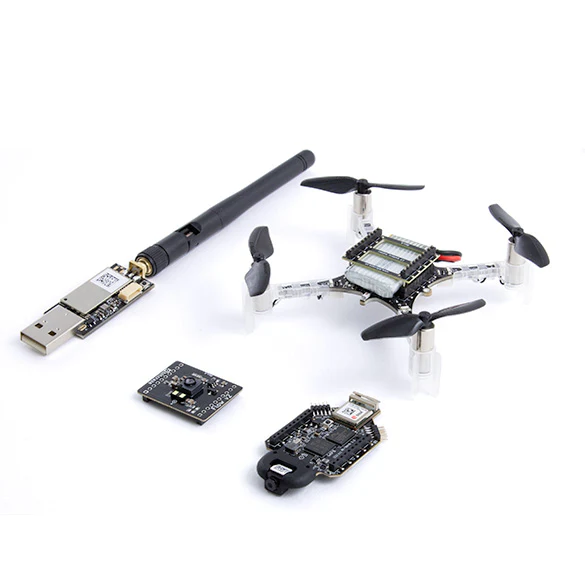
The AI bundle contains everything you need to get started with your flying AI application.
Shop Bundle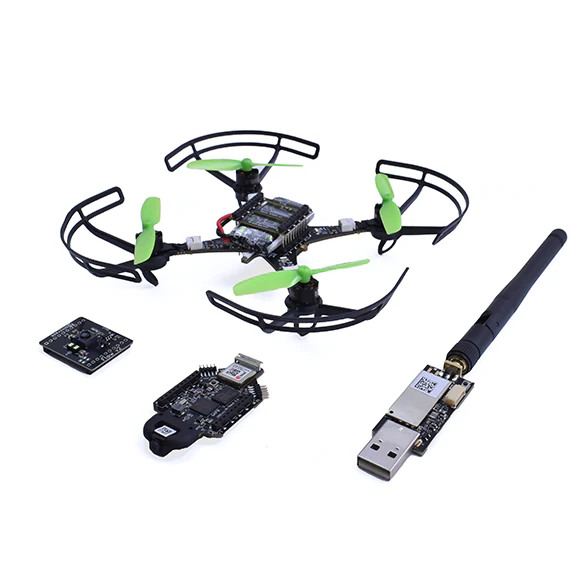
The AI bundle contains everything you need to get started with your flying AI application.
Shop BundleRelated Resources
From visual navigation and sensor fusion to autonomous exploration and obstacle avoidance, the Crazyflie provides a practical and adaptable platform for advancing perception and navigation research.