Assembling the Crazyradio 2.0
The first thing to do is to unpack and assemble the hardware.
Package contents
- 1 x Crazyradio 2.0 USB dongle
- 1 x Antenna
Mount the antenna
Screw the antenna on to the connector on the USB dongle.
Install drivers
Depending on which operating system you use, you may need to install drivers or configure USB permissions before the Crazyradio 2.0 can communicate with your computer. macOS users can skip this section.
Install and configure
Please see the Windows driver installation instructions
On Linux, the Crazyradio is easily recognized, but you have to set up udev permissions. Look at the usb permission instructions to setup udev on Linux.
Enter bootloader mode
To flash new firmware to the Crazyradio 2.0 , it must first be set to the bootloader mode.
Hold button
Press and hold the button.
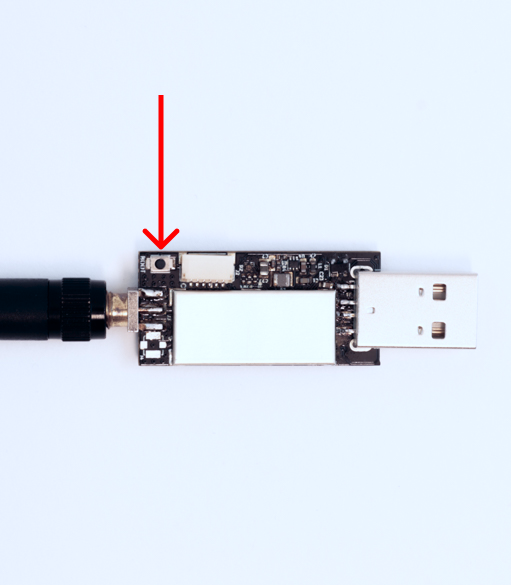
Insert into USB port
Insert the USB dongle into a USB port while holding the button.
Red LED
Verify that the LED is pulsing with a red light. This indicates that the Crazyradio 2.0 is in bootloader mode.
Flash new firmware
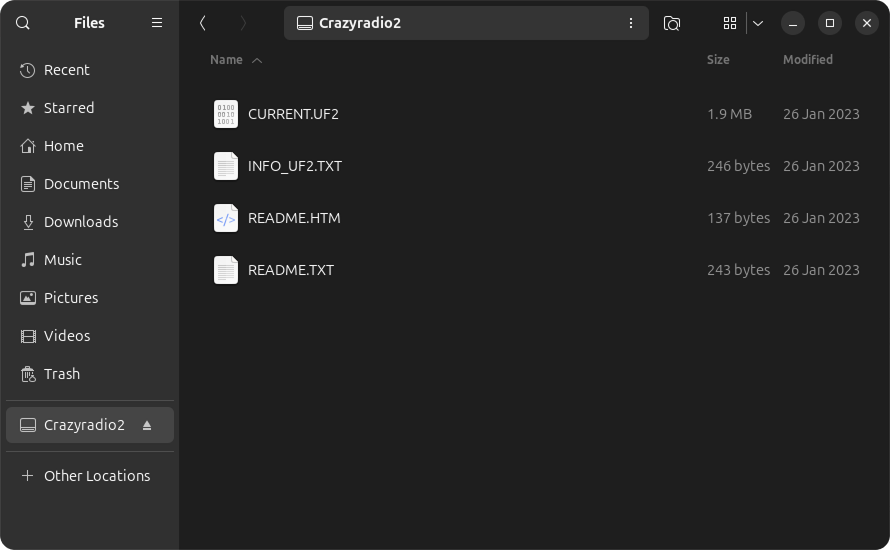
When in bootloader mode, the Crazyradio 2.0 will appear as a USB drive in your operating system. Firmware
is installed by copying a .uf2 firmware file to the drive.
Find the drive
Open a file browser and find the drive named Crazyradio2.
Download firmware
Go to the release page on github. Download the .uf2 file by clicking it.
Install the firmware
In your file browser, drag and drop the downloaded file to the Crazyradio2 drive. The installation completes in less than a second.
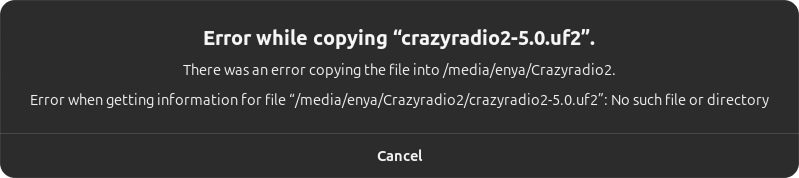
The Crazyradio2 will automatically restart with the new firmware, exiting bootloader mode. This will make the Crazyradio2 USB drive disappear.
You may see an error message from your operating system saying the copy did not complete. This does not necessarily mean that the installation failed, only that the radio restarted, which means that it exited bootloader mode and is therefore not available as a USB drive anymore. Do the check in the next step to make sure that the installation was successful.
Check the installation
To confirm the firmware is running, the LED will briefly flash white on startup.
If you missed it, unplug and re-plug the Crazyradio 2.0 to see the white flash again.
Done!
The Crazyradio 2.0 is now ready to use, and is compatible with all the products in the Crazyflie® ecosystem.