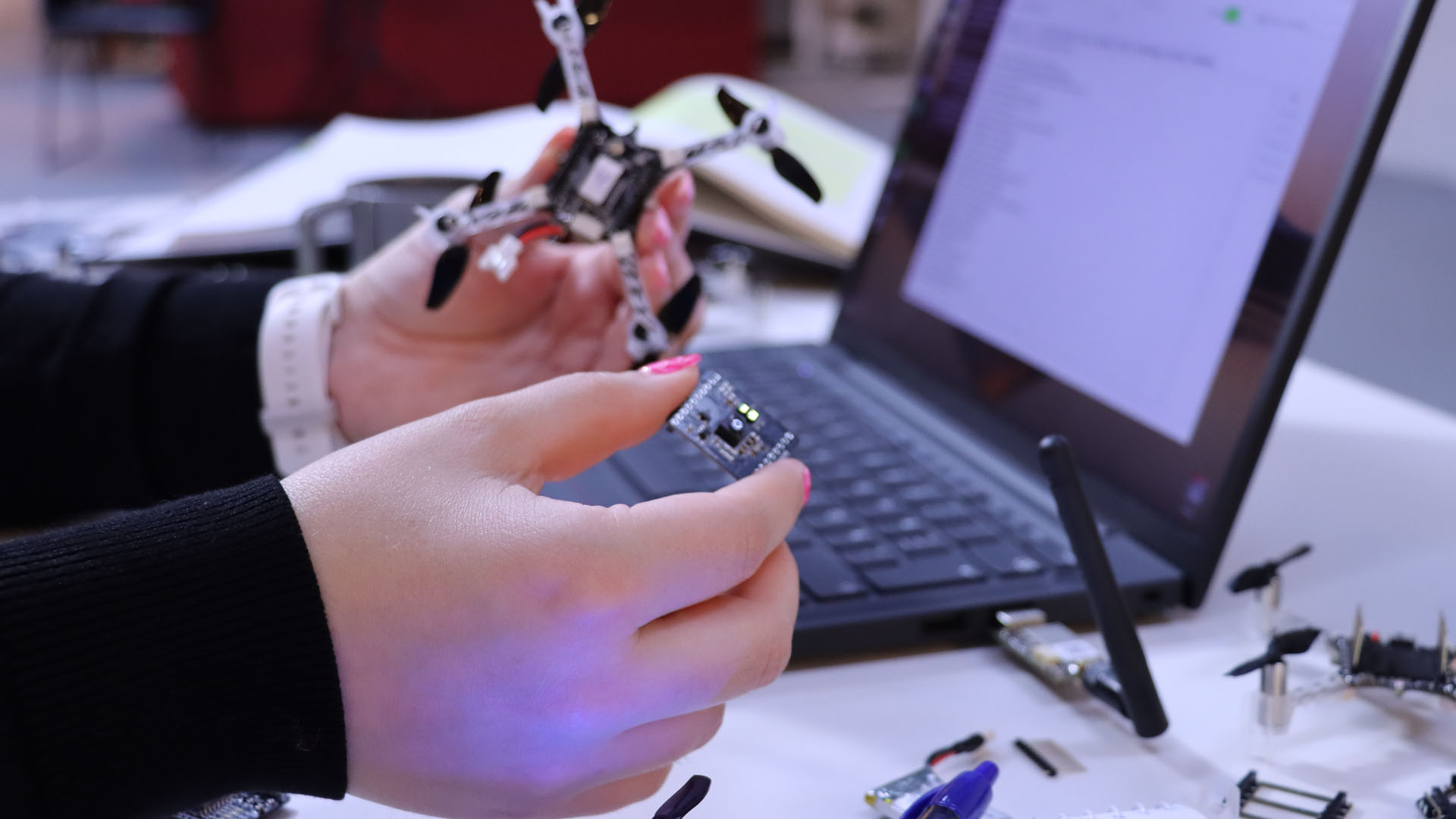
We try to keep up with recent research using the Crazyflie®. We read a lot of papers and check out new GitHub projects, controllers, and simulators. Sometimes the topics are straightforward and sometimes we learn new things from completely unexpected angles. It is such a treat to see where the community is heading, and it helps us prioritize our own work, from new features and functionality to the hardware we develop next.
Most of the time we look at the Crazyflie applicability close up, but two recent studies in particular put it into a bigger context:
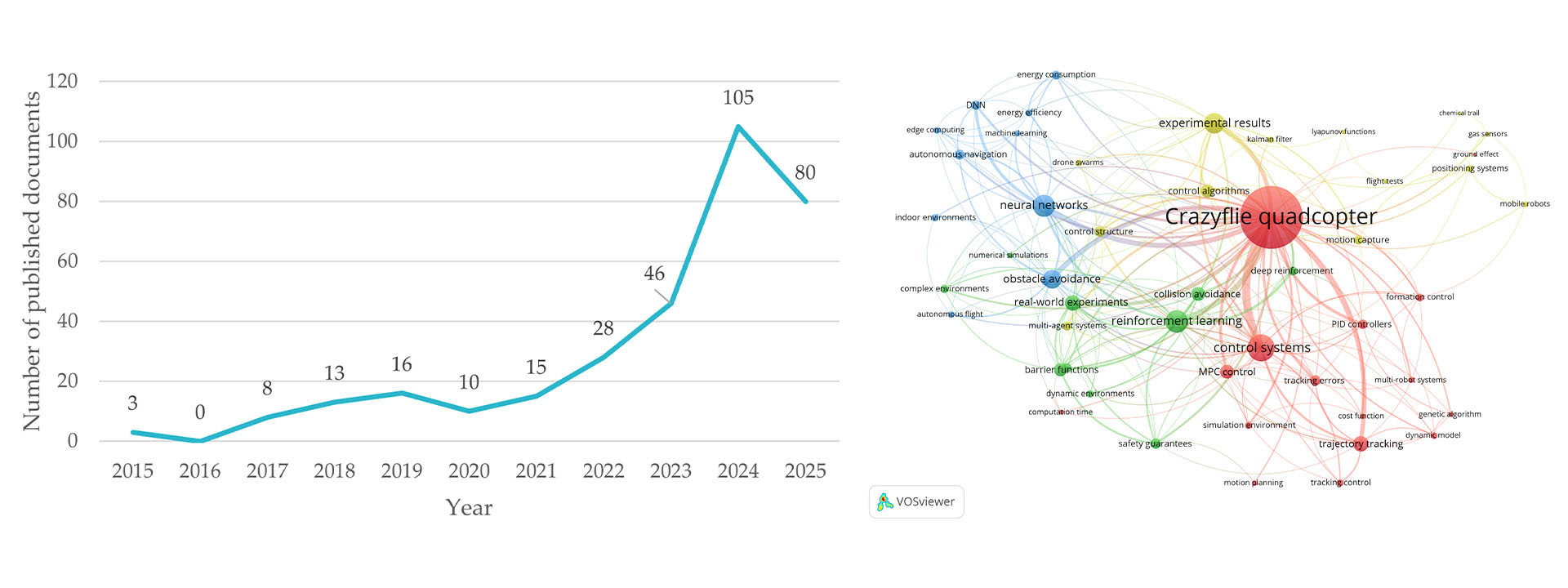
- In their 2026 A Scoping Review of the Crazyflie Ecosystem: An Evaluation of an Open-Source Platform for Nano-Aerial Robotics Research paper, Rareș Crăciun and Adrian Burlacu reviewed the Crazyflie research ecosystem from 2015 to 2025. They identified 321 studies across 183 publication venues, with research spanning control, navigation, swarms, localization, sensing, AI, safety and simulation. The number of publications has grown quickly too, reaching 105 papers in 2024. The authors calculate an annual publication growth rate of 38.9%.
The institutions represented include ETH Zurich, University of Bologna, TU Delft, Università della Svizzera italiana, Tsinghua University and University of Toronto, among many others. For us, the breadth is at least as interesting as the number of papers. The same underlying platform is being used to investigate quite different research questions.
- In their 2026 NanoCockpit: Performance-optimized Application Framework for AI-based Autonomous Nanorobotics paper, Elia Cereda, Alessandro Giusti and Daniele Palossi took a different approach. They surveyed nano-quadrotor research from 2020 to 2024, using Scopus as the primary source and manually reviewed the publications to identify the platforms being used. Their final dataset contains 586 relevant publications and the Crazyflie was used in 381 of them, or 65%. DJI Tello was second with 128 publications, or 21%, followed by Parrot Mambo with 50.
Cereda, Giusti and Palossi describe Crazyflie as the de facto standard platform for nano-robotics research. We’re as vain as the next guy, but we’re mostly interested in what researchers actually benefit from, namely a shared research platform that becomes more useful as the body of reproducible work, software and experimental knowledge around it grows.
Software momentum in the community
The Crazyflie firmware has now accumulated more than 4,000 commits. The repository has around 1,500 stars and more than 1,200 forks, and Bitcraze currently maintains 77 public repositories around the ecosystem.
Some of that work is ours, but a lot of the interesting stuff isn’t. Researchers and developers have contributed controllers, estimators, positioning methods, simulation environments, swarm tools, drivers, fixes and documentation, and many projects live outside our repositories but build directly on the platform.
NanoCockpit is a good example. The researchers took the Crazyflie and AI-deck, found ways to use the available computing resources more effectively, and demonstrated the resulting framework on applications including human pose estimation, relative localization and autonomous drone racing.
Someone else can now build on that, which is what makes the ecosystem useful.
A foundation to build on
The Crazyflie a researcher starts with today is not just the hardware we designed. It comes with years of firmware development, libraries, positioning systems, simulation tools, documentation and published experimental work. Each contribution adds a little more to that foundation, and over time, that compounds.
To everyone who has published with Crazyflie, contributed code, shared a tool, reported a bug, documented an experiment or pushed the platform into a research area we hadn’t anticipated: thank you.
You’re not just using the Crazyflie ecosystem. You’re helping build it.