And so, two of our products have reached the end of the road. This time it is the Z-ranger deck v2 and the Crazyradio PA. Both have now been discontinued, and our remaining stock has run out.
This is not a particularly dramatic change. Both products already have well-established successors, and much of what they enabled has simply become part of the next generation of the ecosystem. Still, they have been around for quite a while, so here’s a proper goodbye.
Z-ranger deck v2: knowing where the floor is
The idea behind the Z-ranger was simple: point a distance sensor downwards and give the Crazyflie a good measurement of its height above the ground. It enabled accurate height hold without an external positioning system and became a building block for early autonomous flight experiments.
The original Z-ranger used the VL53L0x Time-of-Flight sensor. In 2018 we introduced the Z-ranger deck v2, together with the Flow deck v2, using the newer VL53L1x sensor and extending the useful ranging distance. The Z-ranger v2 could measure the distance to the ground up to 4 metres.
There was always a close relationship between the Z-ranger and the Flow deck. The two decks share the same basic downward-facing ranging functionality, but the difference is that the Flow deck v2 also contains a PMW3901 optical flow sensor, allowing the Crazyflie to measure horizontal movement relative to the ground.
Over time, that has made the Flow deck the more useful general-purpose solution. You get the ground-distance measurement of the Z-ranger, but also the motion information needed for position hold and autonomous movement in X and Y.
Rather than maintaining two products with overlapping functionality, we are consolidating around the Flow deck v2. For existing Z-ranger users, nothing suddenly stops working. The firmware support remains, and there is no reason to replace a Z-ranger that is already doing its job in an experiment. For new setups, however, the the Flow deck v2 is now the natural choice.
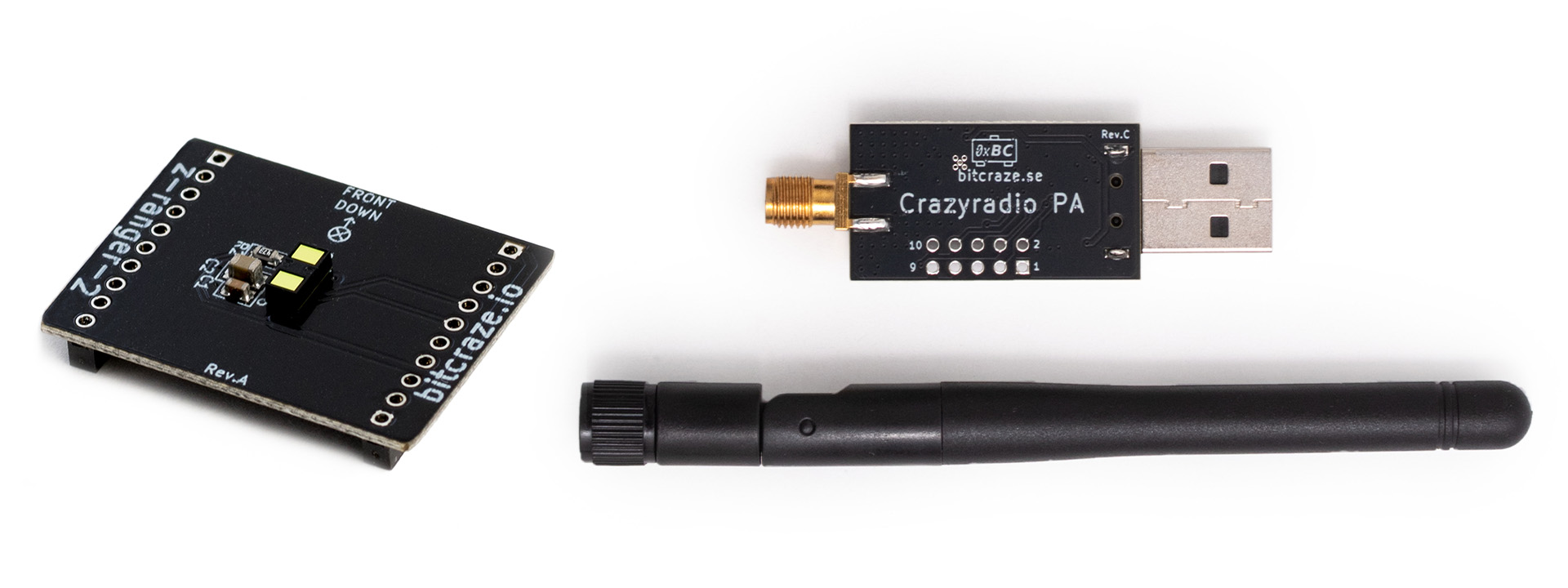
Crazyradio PA: a small USB dongle that did a lot of work
The second product leaving the store is the Crazyradio PA. It has been our main USB radio dongle for communicating with Crazyflies for many years. Based on the nRF24LU1+, with a power amplifier providing up to 20 dBm output power, it provided the communication link behind everything from someone flying their first Crazyflie to fairly substantial research swarms.
By 2023, though, the nRF24LU1+ platform was becoming increasingly limiting for what we wanted to do next. That led to Crazyradio 2.0, based on the much more capable nRF52840. From the beginning, Crazyradio 2.0 was designed both as a replacement for Crazyradio PA and as a platform on which we could continue developing the communication side of the Crazyflie ecosystem. The nRF52840 gives us substantially more processing power, memory and radio flexibility, as well as a more convenient bootloader and room to experiment with new communication protocols and scheduling strategies.
Earlier this year, for example, we flew 49 Crazyflie 2.1 Brushless drones using a single Crazyradio 2.0 while testing cflib2 and improvements to the radio firmware. That is a useful illustration of why moving the radio platform forward matters: communication is part of the research infrastructure too, especially when experiments start scaling from one robot to many.
What changes for existing users?
Not very much is changing for existing users. If you already have a Z-ranger deck v2 or Crazyradio PA, you can continue using them. Discontinuation does not mean that they suddenly become incompatible with the Crazyflie ecosystem.
For new setups, however, use the Flow deck v2 for downward ranging capability and optical flow measurement.
And as far as a radio goes, the Crazyradio 2.0 is the only alternative on which ongoing communication development is focused.