drone show

49 Crazyflie 2.1 Brushless lifting off their charging docks, flying formations, and landing back to recharge, all driven from a single Crazyradio 2.0. That’s what we have been flying lately, and it’s a great showcase of what the Crazyflie ecosystem can do with a big swarm.

If 49 Crazyflies sounds familiar, you might remember 49 Crazyflies, 1 Crazyradio, and cflib2. This time the formations are a lot more dynamic. They come from a collaboration with the Institute for Data Science in Mechanical Engineering (DSME) at RWTH Aachen University, and we recorded some videos we’re really happy with.

Where the formations come from

The choreographies were generated with SWAN, a pipeline developed at DSME that turns text promt into drone trajectories. In short:

  1. A generative video model turns the prompt into a reference video.
  2. A point tracker converts the motion in that video into trajectories for the swarm.
  3. A planner assigns them to individual drones, and a safety filter makes sure they are collision-free.

What makes these formations fun for us is that they are not static shapes: they move in ways that would be hard to animate by hand. That also makes them a demanding test for the swarm.

Taking it to the real world

The generated SWAN trajectories are turned into splines and deployed on a dense swarm of 49 Crazyflie 2.1 Brushless, flying under the Lighthouse positioning system and lit up by bottom-mounted Color LED decks. We won’t go through the whole setup again (covered by the earlier post), but two parts of the Crazyflie ecosystem made this kind of work practical:

  • Built on cflib2. All communication with the swarm goes through cflib2 over a single Crazyradio 2.0. Before takeoff, we use cflib2 to upload each drone’s trajectory to its memory, and during the show, the High-Level Commander executes it onboard. While they are flying, we log every drone’s position every 50ms, giving us a record of how closely the swarm followed the choreography.
  • No battery swapping. Each Crazyflie takes off and lands on its charging dock. When you want to fly the swarm many times back to back, not having to handle 49 batteries makes a huge difference.

The result is a setup where any idea can go from the computer to a real swarm without having to build the infrastructure yourself.

The videos

Enough talking, here is what it looks like. The video below shows the formations we flew: a ballerina (49 drones), a karate fighter (29 drones), and a hand making an “I love you” (ILY) sign (49 drones).

Wrapping up

Flying 49 Crazyflies through dynamic formations, with one radio, full position logging and drones that recharge themselves between flights shows how far the Crazyflie ecosystem has come for large swarms.

A big thank you to Pascal Reinhold, Alexander Gräfe and Sebastian Trimpe at DSME for their awesome work, and an extra special thanks to Alexander, who coordinated the whole project during his internship with us at Bitcraze. If you want to learn more about SWAN, check out their paper, Generative AI for Safe and Photorealistic Drone Light Shows. And if you want to fly your own swarm, cflib2 is ready to try.
Flying formations with a swarm is always fun to develop and watch, but it is also a great way to stress-test the software behind it. As part of the development of cflib2, we put it through one of its toughest tests yet: flying 49 Crazyflies in coordinated formations.

The entire swarm was controlled using a single Crazyradio 2.0, highlighting the combined improvements in cflib2 and Crazyradio firmware over the past few months.

The setup

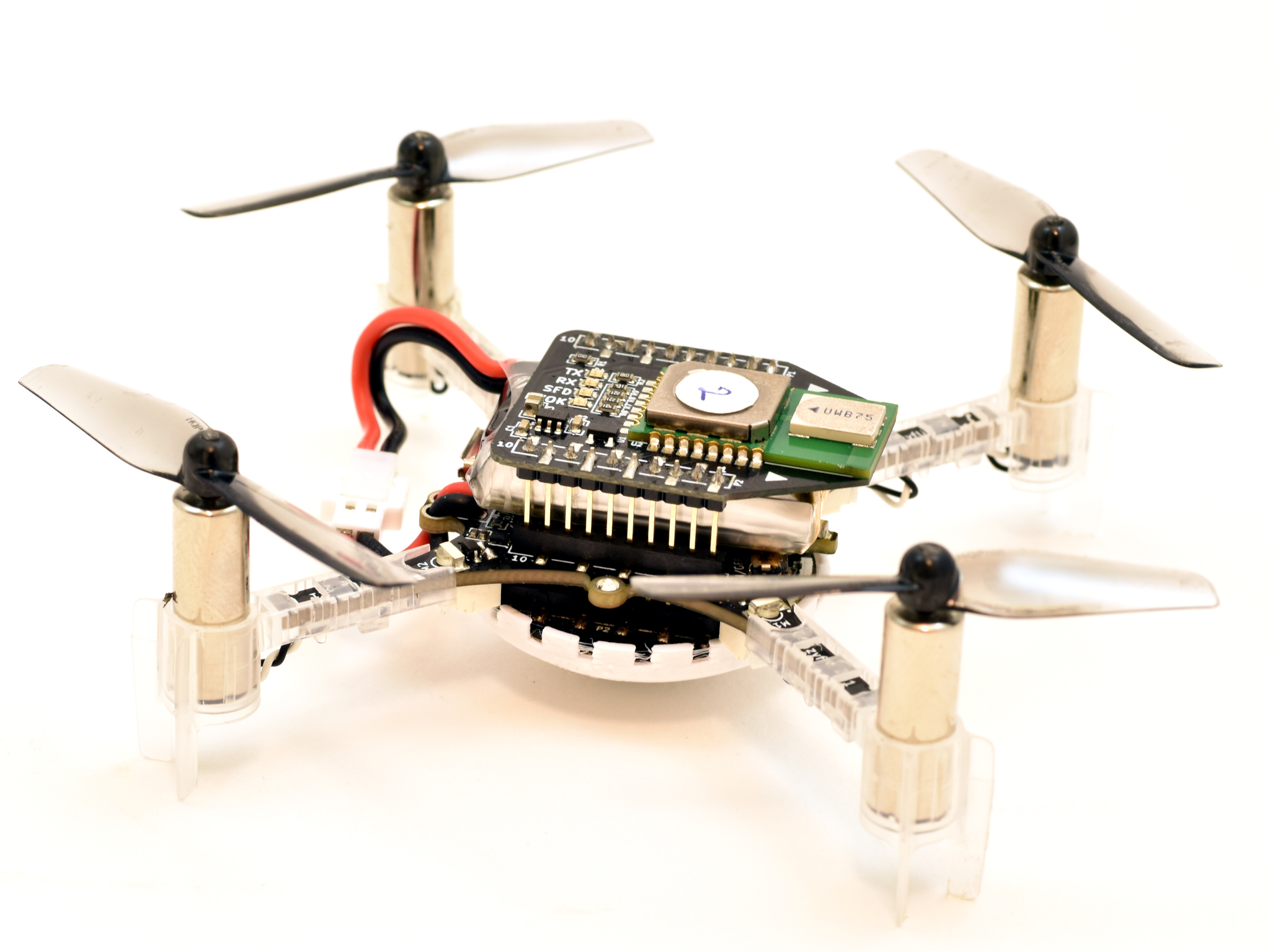
The hardware configuration was relatively straightforward. We used 49 Crazyflie 2.1 Brushless drones, each one equipped with a bottom-mounted Color LED deck for vivid lighting effects. For positioning, we used the Lighthouse positioning system, covering the entire flight area, which was roughly 5x5x2m. Its accuracy allowed the Crazyflies to fly grid formations with just 0.4m spacing between them.

One of the big practical challenges when managing a large swarm is swapping the depleted batteries for charged ones. Thanks to the Crazyflie 2.1 Brushless PCB design, each drone can now charge while sitting on its charging dock, making it much easier to prepare the swarm for the next flight.

Flying the formations

The swarm performed a sequence of synchronized formations under the control of a central PC. Rather than streaming the full trajectories to every drone, the formations are built using the Crazyflie’s High-Level Commander. Each Crazyflie receives simple motion commands such as go to or spiral, and executes the corresponding trajectory onboard. At the same time, it receives commands for changing the color of the Color LED deck.

Using cflib2, these commands can be sent to all 49 Crazyflies through a singe Crazyradio 2.0, which was not possible with cflib.

Looking ahead

This demonstration is an exciting milestone for cflib2 and showcases what the new library makes possible. While controlling 49 Crazyflies is an impressive demonstration, cflib2 is designed to benefit projects of every size. Whether you are flying a single Crazyflie or coordinating a large swarm, the goal is to provide a faster, more scalable, and more robust communication library.

Most of the functionalities from cflib have already been migrated to cflib2, and development is continuing. For many applications, cflib2 is already ready to use, so if you would like to try it out, you can find the repository here.

This year, the traditional Christmas video was overtaken by a big project that we had at the end of November: creating a test show with the help of CollMot.

First, a little context: CollMot is a show company based in Hungary that we’ve partnered with on a regular basis, having brainstorms about show drones and discussing possibilities for indoor drones shows in general. They developed Skybrush, an open- source software for controlling swarms. We have wanted to work with them for a long time.

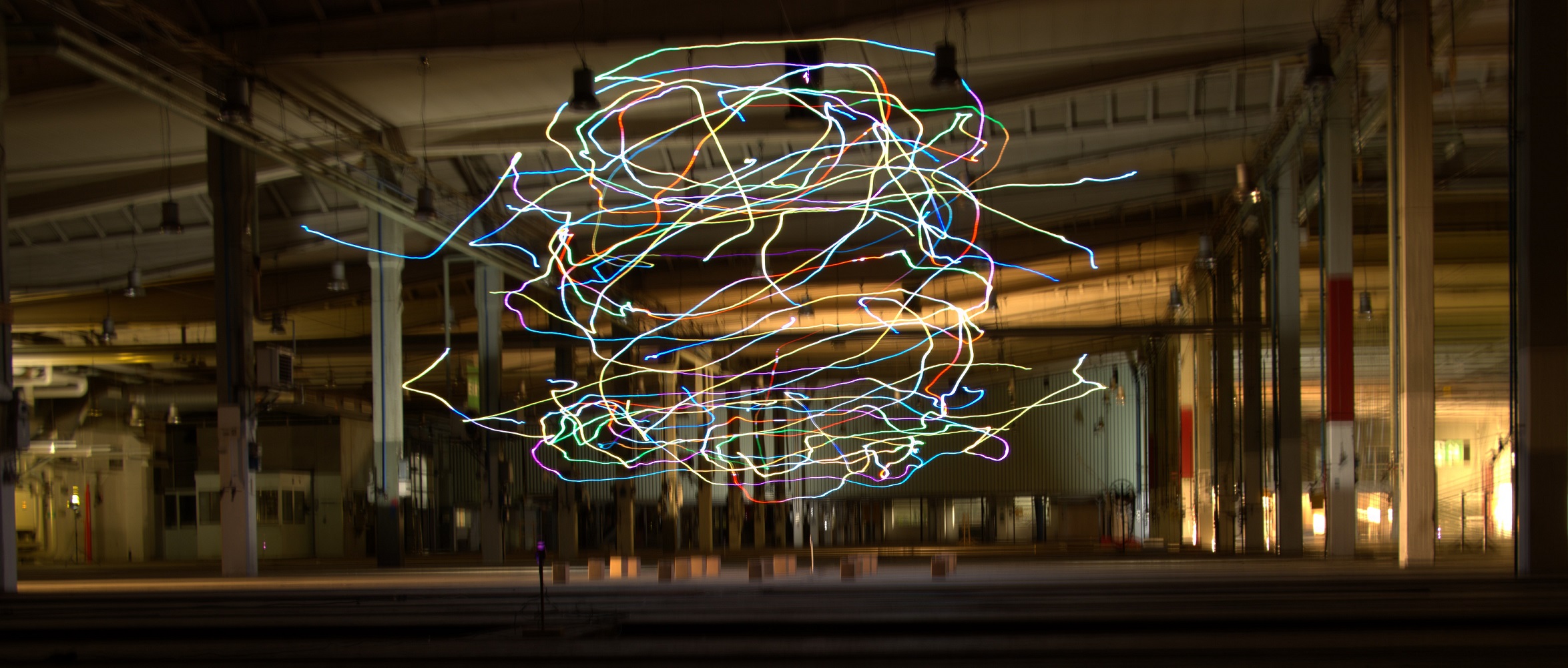
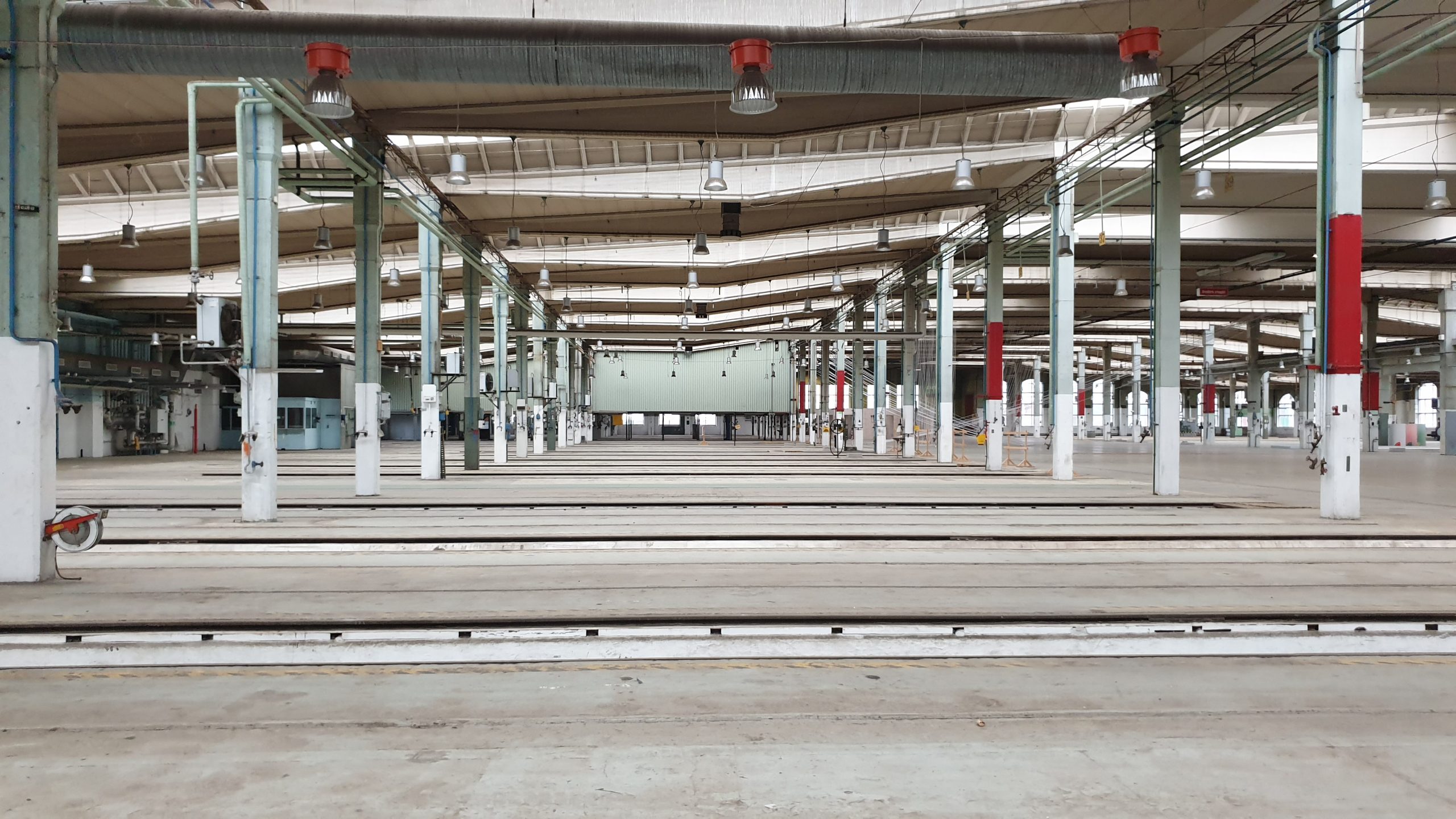
So, when the opportunity came to rent an old train hall that we visit often (because it’s right next to our office and hosts good street food), we jumped on it. The place itself is huge, with massive pillars, pits for train maintenance, high ceiling with metal beams and a really funky industrial look. The idea was to do a technology test and try out if we could scale up the Loco positioning system to a larger space. This was also the perfect time to invite the guys at CollMot for some exploring and hacking.

The train hall

The Loco system

We added the TDoA3 Long Range mode recently and we had done experiments in our test-lab that indicate that the Loco Positioning systems should work in a bigger space with up to 20 anchors, but we had not actually tested it in a larger space.

The maximum radio range between anchors is probably up to around 40 meters in the Long Range mode, but we decided to set up a system that was only around 25×25 meters, with 9 anchors in the ceiling and 9 anchors on the floor placed in 3 by 3 matrices. The reason we did not go bigger is that the height of the space is around 7-8 meters and we did not want to end up with a system that is too wide in relation to the height, this would reduce Z accuracy. This setup gave us 4 cells of 12x12x7 meters which should be OK.

Finding a solution to get the anchors up to the 8 meters ceiling – and getting them down easily was also a headscratcher, but with some ingenuity (and meat hooks!) we managed to create a system. We only had the hall for 2 days before filming at night, and setting up the anchors on the ceiling took a big chunk out of the first day.

Drone hardware

We used 20 Crazyflie 2.1 equipped with the Loco deck, LED-rings, thrust upgrade kit and tattu 350 mAh batteries. We soldered the pin-headers to the Loco decks for better rigidity but also because it adds a bit more “height-adjust-ability” for the 350 mAh battery which is a bit thicker then the stock battery. To make the LED-ring more visible from the sides we created a diffuser that we 3D-printed in white PLA. The full assembly weighed in at 41 grams. With the LED-ring lit up almost all of the time we concluded that the show-flight should not be longer than 3-4 minutes (with some flight time margin).

The show

CollMot, on their end, designed the whole show using Skyscript and Skybrush Studio. The aim was to have relatively simple and easily changeable formations to be able to test a lot of different things, like the large area, speed, or synchronicity. They joined us on the second day to implement the choreography, and share their knowledge about drone shows.

We got some time afterwards to discuss a lot of things, and enjoy some nice beers and dinner after a job well done. We even had time on the third day, before dismantling everything, to experiment a lot more in this huge space and got some interesting data.

What did we learn?

Initially we had problems with positioning, we got outliers and lost tracking sometimes. Finally we managed to trace the problems to the outlier filter. The filter was written a long time ago and the current implementation was optimized for 8 anchors in a smaller space, which did not really work in this setup. After some tweaking the problem was solved, but we need to improve the filter for generic support of different system setups in the future.

Another problem that was observed is that the Z-estimate tends to get an offset that “sticks” and it is not corrected over time. We do not really understand this and will require more investigations.

The outlier filer was the only major problem that we had to solve, otherwise the Loco system mainly performed as expected and we are very happy with the result! The changes in the firmware is available in this, slightly hackish branch.

We also spent some time testing maximum velocities. For the horizontal velocities the Crazyflies started loosing positioning over 3 m/s. They could probably go much faster but the outlier filter started having problems at higher speeds. Also the overshoot became larger the faster we flew which most likely could be solved with better controller tuning. For the vertical velocity 3 m/s was also the maximum, limited by the deceleration when coming downwards. Some improvements can be made here.

Conclusion is that many things works really well but there are still some optimizations and improvements that could be made to make it even more robust and accurate.

The video

But, enough talking, here is the never-seen-before New Year’s Eve video

And if you’re curious to see behind the scenes

Thanks to CollMot for their presence and valuable expertise, and InDiscourse for arranging the video!

And with the final blogpost of 2022 and this amazing video, it’s time to wish you a nice New Year’s Eve and a happy beginning of 2023!