Category: Random stuff

2018 has ended, we at Bitcraze are now back from a short holiday break and we are looking forward to 2019. There is already a lot of things rolling that will give results in 2019 and we wanted to do a short post about what we are currently planning.

Product wise, we still have a couple of product in final state of production that we will be releasing during Q1 or early Q2 2019, Crazyflie 2.1 production is on-going and we have started a first batch of the Lighthouse deck.

We have talked about both projects in previous post but if you want to see what the lighthouse positioning is capable of you can look at the Holiday video we pushed two weeks ago:

This video was made using two HTC Vive base station V1 and prototypes of the lighthouse deck we are currently producing. We intend this deck to be the first version of a series of Lighthouse receiver deck: we had to simplify the design by using only horizontal IR receivers in order to be able to produce a first batch now, this meant making some compromises on the usable flight space. We will talk more on that in a future block post but as you can see in the video the system is promising.

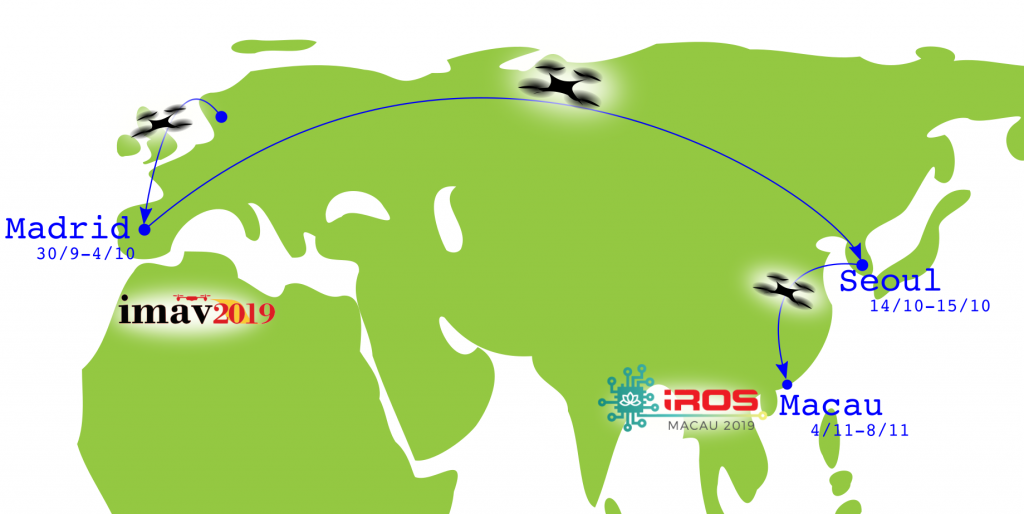
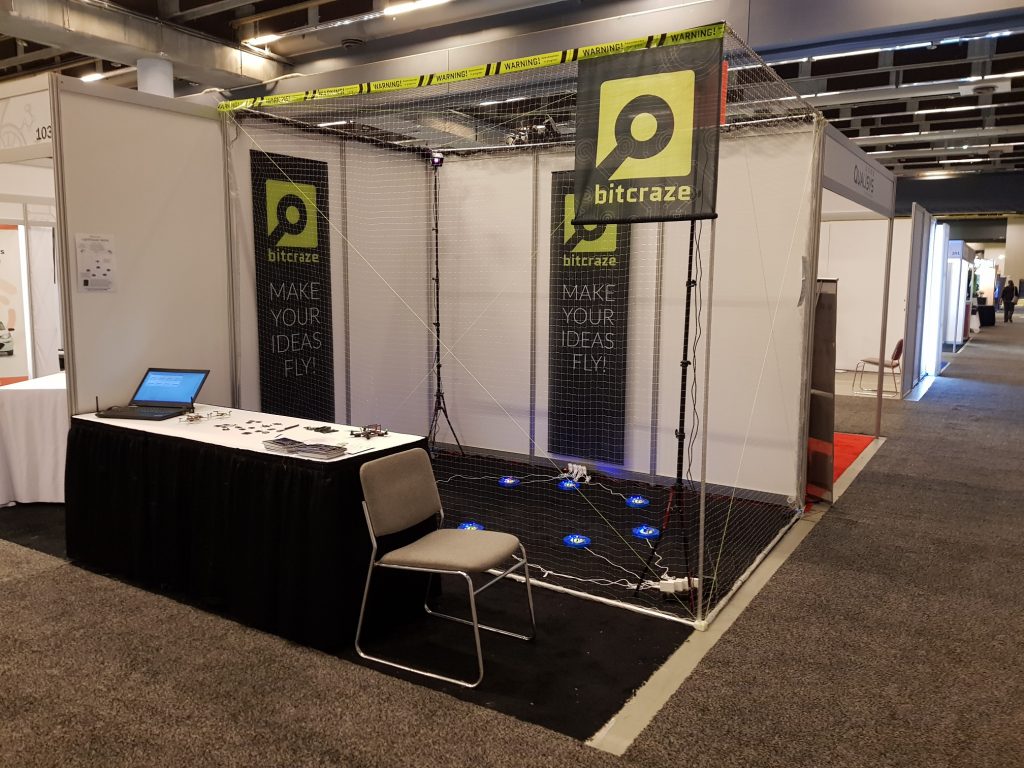
We will also try to travel a bit more this year to meet you. IROS 2018 was an awesome experience and allowed us to meet a lot of our users and to get a better understanding on how Crazyflie is and can be used. This year we are aiming at visiting Fosdem 2019 in Brussels as well as exhibiting at ICRA 2019 in Montreal and IROS 2019 in Macau. None of them are completely finalized yet so stay tuned on the blog for future announcement. If you have other suggestion of conferences or event you would like to see us attending, please tell us in the comments or drop us an mail.

Finally on a company side, we are looking at growing the team and changing office. We are currently 5 at Bitcraze which means that we have a lot to do and growing would allow us to expand the Crazyflie ecosystem with more functionality and cool stuff. We are also going to move to a new office where we will have a dedicated flight lab. Until now we have had our office in a co-working space and we used about 4x4m of our office space as a flight lab. In the new office we will have a dedicated 100m² flight space which will allow us to work more on swarm support and to improve the LPS system in a bigger space.

Another hectic year has passed. We can’t believe it’s been seven years since our first blog post. Only missing a few Monday blog posts over these past seven years makes this post #375! Kind of impressing from a bunch of nerds that rather write code instead of communicative and fun blog posts :-).

As being the last blog post of the year we can’t think of anything better then summarizing 2018.

Community

The community is one of the big motivators for us. We are very, very thankful for your support! You keep us going!

Software

  • On the Loco positioning side there has been a lot of focus on TDoA, aka swarm positioning. During the year we managed to release TDoA2 and TDoA3 as experimental. Read more about the algorithms in their respective blog post.
  • The Crazyswarm fork was merged into master, thanks again USC ACT Lab!
  • Together with Qualisys we continued the work to add support for their MoCap cameras to the Crazyflie system.
  • It might not be correctly classified as software but we released a new front page!
  • Firmware and Software release 2018.10 packs a lot of new stuff.

Hardware

Logistics

We can’t summarize 2018 without a note about the logistics problems we had which made us move the stock to our office in Malmö. Who figured it could be that hard! For those that had to wait a long time for their packages, we apologize. The good news is that it is much better now and logistics will work flawlessly in 2019!, hopefully… :-)

A few weeks ago we wrote about the release of the Multi-ranging deck and the new STEM ranging bundle.

The STEM ranging bundle is a great addition in the classroom for a wide range of students. By combining the Flow deck v2’s time-of-flight distance sensor and optical flow sensor with the Multi-ranger deck’s ability to measure distance to objects, the Crazyflie gets position and spatial awareness.

We have shot a video that shows the bundle in action!


To get started with the STEM ranging bundle we have created a guide for the bundle with step-by-step instructions. The code for the demos in the video are available in the example directory of the crazyflie-lib-python project:

  • multiranger_push.py: When the application in launched the Crazyflie will take off and hover. If anything is getting close to the right/left/front/back sensors the Crazyflie will move in the opposite direction. 
  • multiranger_pointcloud.py: When the application is launched the Crazyflie will take off, hover and a 3D-plot will be shown of what is detected by the Multi-ranger deck sensors. By default the left/right/front/back/up sensors will be plotted, but you can also add the Crazyflie position and the down sensor if you like. The Crazyflie can be moved around by using the arrow keys on the keyboard and w/s for up/down and a/d for rotating CCW/CW. For more info see the documentation in the example.

We love feedback so please leave some comments in the field below!

Even though we are getting closer to Christmas and hopefully some well deserved rest, there are lots of things going on at Bitcraze. This week we have collected news about various topics that we wanted to share with you.

China

Tobias and Marcus visited our Chinese manufacturer Seeed last week in Shenzen. We are trying to visit Seeed at least once a year to meet in person rather than only via the internet. 

huaqiangbei

It is always a great experience to visit Shenzen and it seems as things are moving at blazing speed over there, with amazing changes from year to year. Such as that you can now paying with face recognition in the grocery store and park you car in automatic parking garages.

Lighthouse deck

We are making progress on the Lighthouse front and we have a preliminary hardware design for the first version of the deck. There are still a lot of things to be done but we hope we will be able to order the first batch soon and that it will be available in our store the first quarter next year.

Qi charger V1.2 deck

The Qi charger deck is compatible with the Qi V1 standard. Recently we have been testing the deck with a new off-the-shelf charger and discovered that the deck was not working with the new charger. After investigating we discovered that the Qi deck is not compatible with the new Qi V1.2 chargers. We started a redesign of the board and we have now started to produce a batch of Qi deck V1.2 that is compatible with Qi 1.2 chargers. The new Qi deck will be released early January.

Roadrunner

The Roadrunner is our first stand alone Tag for the Loco Positioning System. It is in essence a Crazyflie with an integrated LPS deck but without motors and a different form factor, it was initially developed for an external project to track go-karts on a racing track. The Roadrunner can be fitted to anything that you want to track in a Loco Positioning System, a ground robot for instance. Since it is based on the Crazyflie, all the libraries and tools that are available in the Bitcraze eco-system are compatible. We plan to start selling the Roadrunner in our store in the beginning of next year.

The Crazyflie Z-ranger and Flow decks share one sensor: the VL53 ranging sensor that provides mm-precision by measuring the time of flight of laser pulses. The manufacturer of this sensor has released an improved version, the VL53L1x that works for longer distances compare to the old one. The old sensor worked for distances up to 1 meter while the new one works up to 2 meters.

The Z-ranger deck interfaces a VL53 sensor facing downwards underneath the Crazyflie, it allows to implement very precise altitude-hold by using the ranging to the floor as absolute height.

The Flow deck has both a down-facing VL53 for height measurements as well as an optical flow sensor for position measurements that allows the Crazyflie to hold its height and fly at constant velocity.

We have released both the Z-ranger V2 and Flow V2 which allows to achieve accurate altitude hold and position hold at much higher heights. With the Flow V2 and Z-ranger V2 it is possible to fly almost all the way up to the ceiling in an ordinary room!

Both decks are available in the Bitcraze online store.

In August we got invited by Marion from ETH Zurich to help out with this years PolyHack, that is organized by Telejob, and which theme was about drones. We really like this kind of events but our reality is that we normally don’t have enough time to participate. For this occasion though we had the opportunity to both have fun and see how our products work when used during an event like this. Two birds with one stone and the decision was made.  Together with one of the main sponsors ELCA, we organized the flying postman challenge:

Drones seem to be the future of post deliveries, but how is it going to work? Join us to reproduce a swarm of drones delivering parcels through a city to have a glimpse at this future!

The challenge the teams got was to deliver as many parcels within 5min in a miniature city, 4m x 4m, using Crazyflies. Since the Crazyflies can’t carry that much payload the parcels was just digital/imaginary but had to be picked up at a pick-up zone. They were allowed to use up to thee Crazyflies simultaneous to increase capacity. For more details checkout the challenge description.

To manage the challenge ELCA developed the CrazyServ which uses a REST API to control Crazyflies, wrapping the high level position commander, and to pick-up parcels. One nice benefit with a server is that it can keep track of which parcels has been picked up and been delivered making the scoring fully automatic.

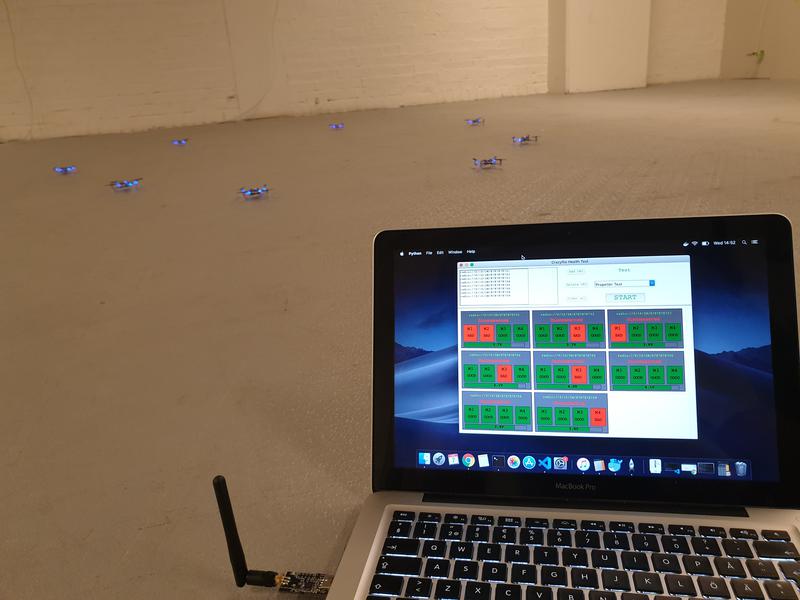
Bitcraze part in the challenge was to bring drones, technical support and our loco positioning system to make up the 4m x 4m city. Or actually three of them, as there were going to be six teams competing for the victory. The initial information was that the three systems would be installed in separated rooms, far away, but we ended up having them side by side. That left us with some live-hacking, changing from TDoA-2 to TDoA-3 so the anchors would not interfere with each other. We ended up using 12 anchors in total which gave enough precision for the PolyHackers to complete their challenge.

The PolyHack was a success and we had a great time. The winning team in our challenge, Electek Innovation, managed to deliver 19 parcels during the 5min with the use of a “loop” system. Congrats and well done! If you get inspired by this hackaton the CrazyServ is available on github! Together with a e.g. swarm bundle it shouldn’t be to hard to reproduce.

Thanks Telejob for letting us take part of this great event!


During the fall there’s been a lot of things going on in production. Like we wrote a couple of weeks ago we’re releasing lots of new hardware during the fall and in the meantime we’re of course continuing to manufacture batches of the previous products. Unfortunately things don’t always run smoothly as one would hope. We’ve hit a few bumps in the road and we wanted to share the latest status so you know what’s going on. As always the times stated below are our current best estimate, but we’re expecting the current issues to be sorted out within a couple of weeks.

Photo by frank mckenna on Unsplash

Crazyflie 2.0 / Battery charger kits (with battery)

Due to an issue with battery sourcing the last batch has been delayed for some time. This has now finally been solved and a both of these products should be available within a few weeks, and with them the bundles that depend on them (like the Swarm bundle).

Flow deck v2

Shortly after shipping the first units customers noticed issues due to the deck connector not fully connecting all the pins. After investigating this with our manufacturer we’ve found the source of the problem: The test rig where the final testing is done was actually deforming the metallic connectors inside the female connector on some of the units. Right now the factory is re-working the effected units and as soon as they are finished we will stock the deck again. Unfortunately there’s no update yet to when the re-worked decks will be available, but we’re estimating a couple of weeks. We will contact the customers that have gotten faulty boards shortly and organize a replacement.

Multi-ranger

Finally the multi-ranger deck has been manufactured and is undergoing final testing. The deck should be available within a couple of weeks.


Last week we have been focusing on making a release for nearly all our firmware and software. This was done mainly to support the new products we will release this fall but it also contains a lot of other functionality that have been added since the previous release. In this blog-post we will describe the most important features of this release.

New Loco Positioning status and configuration tab

New deck support

The Crazyflie firmware and Crazyflie client 2018.10 adds support for a range of new decks that are about to be released:

  • Flow deck V2 and Z-Ranger V2: New versions of the flow and Z-Ranger deck that uses the new VL53L1 distance sensor. Drivers are implemented in the Crazyflie firmware and the client has been updated to allow flying up to 2 meter in height hold and hover modes when the new decks are detected.
  • Multiranger deck: Diver for the new Multiranger deck is implemented in the Crazyflie firmware, support code is now present in the lib as well as an example implementing the push demo that makes the Crazyflie fly in hover mode using the flow deck and move away from obstacles:

The Flow deck V2 is already available in our webstore. The Z-Ranger V2 and Multiranger will be available in the following weeks, stay tuned on the blog for updated information.

Crazyswarm support

During the year, functionality implemented for the Crazyswarm project has been merged back to the Crazyflie firmware master branch. Practically it means that the Crazyflie firmware 2018.10 is the first stable version to support Crazyswarm. The main features implemented by Crazyswarm are:

  • Modular controller and estimator framework that allows to switch the estimator or the controller at runtime. Practically it means that it is not required to recompile the firmware to use a different controller anymore.
  • Addition of a high-level commander that is able to generate setpoints for the controller from within the Crazyflie. The high-level commander is usable both from Crazyswarm and from the Crazyflie python library. It currently has commands to take-off, land, go to a setpoint and follow a polynomial trajectory. It is made in such a way that it can be extended in the future.
  • Addition of the Mellinger controller: a new controller that allows to fly much tighter and precise trajectories than the PID controller. It is tuned pretty tight so it is currently mostly usable using a motion capture or lighthouse as positioning and togeather with the high-level commander.

Improved and more stable Loco Positioning System

A lot of work has been put in the Loco Positioning System (LPS) this summer. The result of this work is the creation of a new ranging mode: TDoA3. TDoA3 allows to fly as many Crazyflie as we want in the system and to add as many anchors are needed, see our previous blog-post for more information. With this release TDoA 3 is added as a stable ranging mode for LPS. The added features related to LPS are:

  • Added TDoA3 as a ranging mode in the LPS-Node-firmware, the Crazyflie 2.0 firmware and the Crazyflie client
  • Revampted the Crazyflie client LPS tab and communication protocol to handle more than 8 anchors
  • Implementation of a new outlier detector for TDoA2 and TDoA3 that drastically improve positioning noise and flight quality

Release notes and downloads

As usual the release build and release note is available on Github. The Crazyflie client and lib are also available as python pip package as cfclient and cflib.

In this blog post we will describe one of the demos we were running at IROS and how it was implemented. Conceptually this demo is based on the same ideas as for ICRA 2017 but the implementation is completely new and much cleaner.

The demo is fully autonomous (no computer in the loop) but it requires an external positioning system. We flew it using either the Loco Positioning System or the prototype Lighthouse system.
A button has been added to the LPS deck to start the demo. When the button is pressed the Crazyflie waits for position lock, takes off and repeats a predefined spiral trajectory until the battery is out, when it goes back to the door of the cage and lands.
For some reason we forgot to shoot a video at IROS so a reproduced version from the (messy) office will have to do instead, imagine a 2×2 m net cage around the Crayzflie.

Implementation

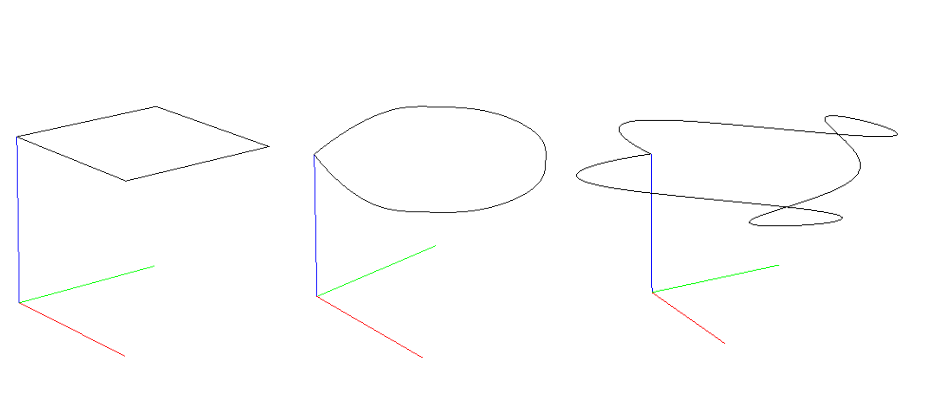
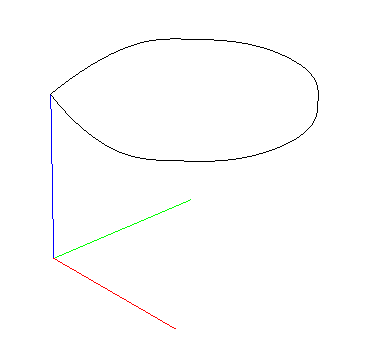
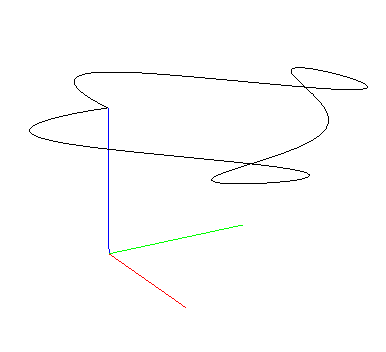
As mentioned in an earlier blog post the demo uses the high level commander originally developed by Wolfgang Hoenig and James Alan Preiss for Crazyswarm. We prototyped everything in python (sending commands to the Crazyflie via Crazyradio) to quickly get started and design the demo . Designing trajectories for the high level commander is not trivial and it took some time to get it right. What we wanted was a spiral downwards motion and then going back up along the Z-axis in the centre of the spiral. The high level commander is a bit picky on discontinuities and we used sines for height and radius to generate a smooth trajectory. 

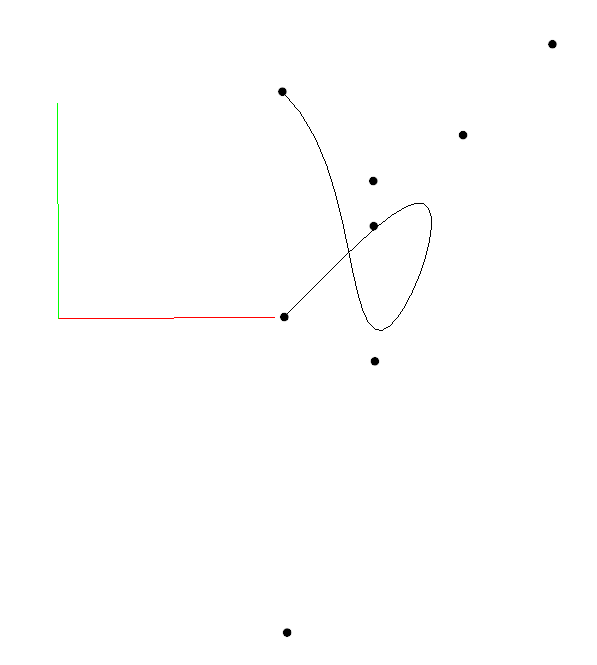
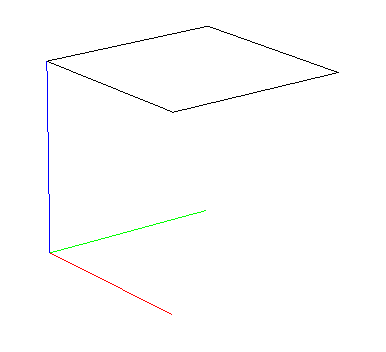
Trajectories in the high level commander are defined as a number of pieces, each describing x, y, z and yaw for a short part of the full trajectory. When flying the trajectories the pieces are traversed one after the other. Each piece is described by 4 polynomials with 8 terms, one polynomial per x, y, z and yaw. The tricky part is to find the polynomials and we decided to do it by cutting our trajectory up in segments (4 per revolution), generate coordinates for a number of points along the segment and finally use numpy.polyfit() to fit polynomials to the points. 

When we were happy with the trajectory it was time to move it to the Crazyflie. Everything is implemented in the app.c file and is essentially a timer loop with a state machine issuing the same commands that we did from python (such as take off, goto and start trajectory). A number of functions in the firmware had to be exposed globally for this to work, maybe not correct from an architectural point of view but one has to do what one has to do to get the demo running :-) The full source code is available at github. Note that the make file is hardcoded for the Crazyflie 2.1, if you want to play with the code on a CF 2.0 you have to update the sensor setting

This approach led to an idea of a possible future app API (for apps running in the Crazyflie) containing similar functionality as the python lib. This would make it easy to prototype an app in python and then port it to firmware.

Controllers

The standard PID controller is very forgiving and usually handles noise and outliers from the positioning system in a fairly good way. We used it with the LPS system since there is some noise in the estimated position in an Ultra Wide Band system. The Lighthouse system on the other hand is much more precise so we switched to the Mellinger controller instead when using it. The Mellinger controller is more agile but also more sensitive to position errors and tend to flip when something unexpected happens. It is possible to use the Mellinger with the LPS as well but the probability of a crash was higher and we prioritised a carefree demo over agility. An extra bonus with the Mellinger controller is that it also handles yaw (as opposed to the PID controller) and we added this when flying with the Lighthouse. 

Going faster

Since the precision in the Lighthouse positioning system is so much better we increased the speed to add some extra excitement. It turned out to be so good that it repeatedly almost touched the panels at the back without any problems, over and over again!

One of the reasons we designed the trajectory the way we did was actually to make it possible to fly multiple copters at the same time, the trajectories never cross. As long as the Crazyflies are not hit by downwash from a copter too close above all is good. Since the demo is fully autonomous and the copters have no knowledge about each other we simply started them with appropriate intervals to separate them in space. We managed to fly three Crazyflies simultaneously with a fairly high degree of stability this way.